From the Apex · Axle to Grind ·
The most advanced thing at Monterey this year was a six-speed manual
Ten days, thirty-five events, three quarters of a billion dollars at auction, and nearly every car that mattered had three pedals. Car week 2026 was the analogue counter-revolution, and Gordon Murray led it.
- Monterey Car Week 2026 moved roughly $750 million at auction, nearly double last year, and crowned a Clark Gable Duesenberg at the 75th Pebble Beach Concours.
- The week's headline reveals, the GMSV S1, McLaren McL 6GT, Hennessey Blackbird and Spyker's comeback, all carry a manual gearbox. Most sold out before the covers moved.
- The S1 is the closest thing to a McLaren F1 successor that will ever exist, and all 64 were gone before the reveal.
- Aston Martin's Valen is a beautiful car doing the unglamorous job of servicing a £1.5 billion debt pile.
The rarest commodity on the Monterey Peninsula this August was not horsepower or carbon fibre. It was a gearlever.
For ten days every August, the Monterey Peninsula becomes the closest thing car culture has to Mecca. Car week 2026 ran from 7 to 16 August and stacked more than 35 events into the stretch: Motorlux opening the show among the jets at the Monterey Jet Center, four days of historic racing at the Rolex Monterey Motorsports Reunion at Laguna Seca, themed this year around the icons of Japanese motorsport, the Tour d'Elegance parading Sunday's concours entries down the coast, The Quail on Friday, and a split-personality Saturday on which Concorso Italiano celebrated 100 years of Ducati while the Concours d'Lemons celebrated the world's worst cars across town. Monterey, to its credit, has a sense of humour about itself. It all funnels into Sunday on the 18th fairway at Pebble Beach, where the 75th Concours d'Elegance gave Best of Show to a 1935 Duesenberg SSJ Speedster first owned by Clark Gable.
The money was historic too. The auction houses moved roughly three quarters of a billion dollars, nearly double last year. A Shelby Cobra Daytona Coupe became the most expensive American car ever auctioned at $42.9 million, breaking a record set in 2018 by, delightfully, the same Duesenberg that took Best of Show two days later. Nick Mason's McLaren F1 GTR became the most expensive British car ever sold at $34.7 million. And the first production Ferrari Luce, chassis number zero of the EV I had opinions about in June, raised $40 million for charity, making it the most expensive electric car in history.
But the tents were the surface. Walk the lawns and a pattern emerged: the headline reveals were naturally aspirated, or manual, or both, and most were sold before the public saw them. The future took the week off. Here is the tour.
Gordon Murray built the last McLaren F1
The easy joke is that Gordon Murray keeps redrawing the McLaren F1. The honest answer is that he can do it as many times as he likes, because this time he has landed it. The Gordon Murray Special Vehicles S1, revealed at The Quail with Dario Franchitti on stage, is the road-going evolution of last year's extreme S1 LM: every body panel new except the roof, the wings and skirts stripped away for active rear aero, and a bespoke Cosworth 4.2-litre V12 with 690 PS spinning to 12,100 rpm through a six-speed manual. Under a tonne. Three seats, driver in the middle. A gold-plated heat shield in the engine bay, because the F1 had one. Sixty-four will be built, one for every McLaren F1 road car, and all 64 were allocated before the covers came off.
And a word for the launch colour. It is a pale, milky heritage green, an actual painted finish GMA has not even publicly named, and not one square inch of it is naked lacquered carbon weave. After a decade of hypercars dressed like laptop lids, it is pure class.
Fairness requires a footnote the fans skip: the F1's shape was not Murray's pen. Peter Stevens styled that car, and Stevens has not been generous about the tribute act. When the S1 LM appeared he wrote that it looked like it had been produced "on the keyboard of a CAD program by someone wearing boxing gloves". He is entitled to the barb; he drew one of the most beautiful objects of the century. But for those of us who had the F1 on our bedroom walls, the S1 is it. This is the pinnacle. I am 35 years old and I would still Blu-Tack a flimsy paper poster of this car above my desk.
There is also this. Murray disclosed last year that he had been treated for oesophageal cancer, diagnosed in early 2024. The S1 LM was developed while he was in chemotherapy, and his chief executive credits the project with carrying him through treatment. Watching him talk about cars, all mechanical sympathy and first principles, remains one of the quiet joys of this hobby. He says there will never be another car like this one. I wish him many more years to be wrong about that.
McLaren finished Bruce's car
Bruce McLaren died at Goodwood on 2 June 1970, aged 32, testing a Can-Am car. The road car he was developing at the time, the M6GT, died with him after a handful were built; he used the prototype, registration OBH 500H, as his daily. Fifty-six years later, McLaren showed the McL 6GT at its own brand house near Pebble Beach: a carbon-tubbed, rear-driven V8 concept with hydraulic steering and the company's first manual gearbox since the F1. The design archaeology is painstaking. The kammback tail, the canopy glasshouse and drop-down headlamps, OBH 500H reimagined as a tone-on-tone graphic, the early Speedy Kiwi logo machined into the gearknob, Bruce's signature on the engine cover. Production follows in 2028, above the core range. This one needs to succeed, and if it does not it will be because too many buyers at this altitude want appreciating garage sculpture rather than a car. Bruce built cars to be driven. So is this one, and that should not feel radical.
Aston Martin, beautiful and broke
The Valen, Latin for strong, is Aston Martin's Monterey special: a 150-unit, front-engined coupe with an 838 bhp twin-turbo V12, billed as the most powerful front-engined production car ever, deliveries from 2027, price politely unspoken but estimated north of £1.5 million. Eh, you might say, another limited edition. You would be right, and that is the point. Aston is carrying £1.5 billion of net debt, its shares sit around 34p against an IPO price of £19, July brought an expensive refinancing, and it was the limited-run specials that did almost all of the margin work in the first half of this year. This company is not so much launching cars as bailing water with them, beautifully.
And I want them to make it, because nobody else builds objects like this while drowning. Even the SUV they were dragged kicking and screaming into building, the DBX, turned out a masterclass of form and function in harmony, all emotion and leather soft as a baby's bottom. Companies this good at beauty should not be this bad at money, and yet here we are, and the specials keep the lights on.

The comeback, the crypto money, and the Blackbird
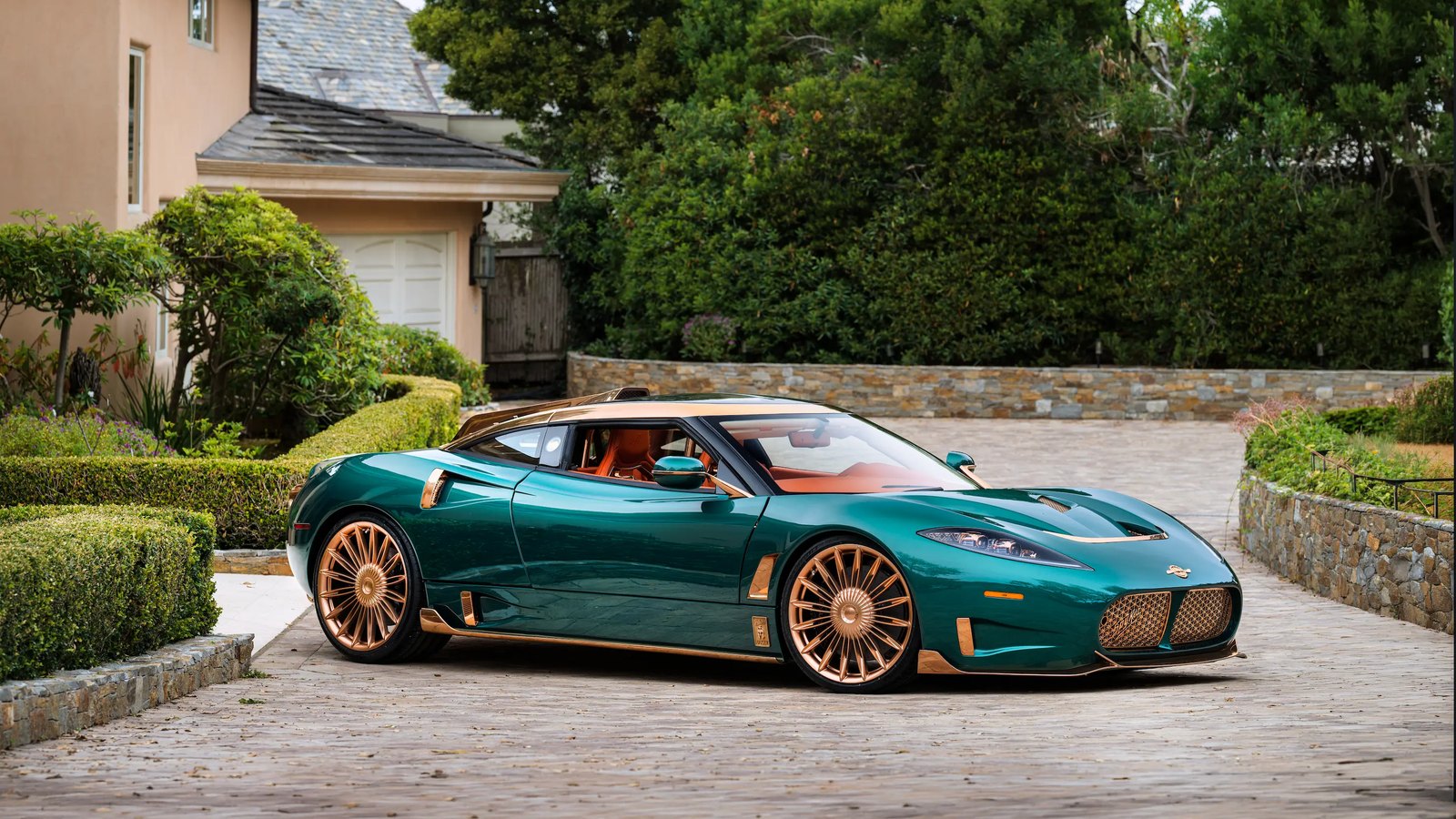
Spyker is back, for the third time. The C8 Preliator XXV, shown at The Quail in Quail Green with rose-gold brightwork, is a 25-car run at about €1.5 million each: an 800 hp Audi-sourced V8, a six-speed manual, hand-formed aluminium. Victor Muller personally recovered the marque's IP after the 2021 bankruptcy, and the money this time is crypto, via co-owner Volodymyr Nosov of the exchange WhiteBIT. Nineteen were reportedly sold by mid-week. The show car arrived with bits of its interior unfinished, which is the most Spyker detail imaginable. Gorgeous, hopeful, unproven.
Then Hennessey. Twice Top Gear has sat John Hennessey at a table with Mate Rimac and Christian von Koenigsegg, once, in 2023, with Gordon Murray there too, and as I remember those comment sections, they were brutal: the consensus was that a tuner had been seated with the engineers on a technicality. The Blackbird is his answer, and it has shut the haters up properly. Seventy-one cars for the SR-71 that names it, $2.5 million each, a naturally aspirated 6.2-litre V8 co-developed with Ilmor revving past 9,000 rpm, a gated manual, a sub-1.4-tonne target, no screens whatsoever, and vertical stabilisers that deploy at 71 mph and rake to 71 degrees. That last detail is the kind of obsession the internet previously reserved for the Swede at that table. Still simple in ethos, now with a design worthy of the name it borrows.
The incumbents were not idle either. Koenigsegg's CCGT1, a road-legal ghost of its stillborn GT1 racer with up to 1,600 hp on E85 and an optional gated manual, sold all 70 within hours. Bugatti's one-off Destrier, a road-legal, re-bodied Bolide in Sapphire Celeste standing barely a metre tall, held the Quail's concept lawn like a piece of sculpture.

axler8's take
None of these cars will ever meet an Indian RTO, and the axler8 recommendation engine will never score one. But Monterey is worth an Indian buyer's attention for what it reveals about value. The people at the top of this market can afford anything, which makes them the purest possible experiment in what humans actually want from a car once every number is affordable. This year they voted, with three quarters of a billion dollars, for revs, gearlevers, paint over bare carbon, and cars finished in colours with stories instead of specs.
Specification is what you compare when you are choosing. Character is what you pay for when you no longer have to compare. The engine handles the first part; it has no opinions about the second. The most advanced thing at Monterey this year was a six-speed manual, and no spreadsheet, mine included, can score why that made grown adults queue on a golf course. I can only report that it did, and that I understood them completely.