From the Apex · Axle to Grind ·
The ES was always the pretty cousin. The new one has made the boring Camry the car to want.
The new ES 350h costs ₹66.10 lakh, hides its buttons and drops the reclining rear seat. The ₹48.69 lakh Camry, built on the same floor in Bidadi, kept all of it.
- The new ES 350h is longer, quicker and goes further on a tank than the ES 300h it replaces. None of that is why anyone bought an ES.
- The rear seat no longer reclines, the sunblinds are gone on the hybrid, and the switches stay hidden until you reach for them. The old car had all three.
- The Camry sits on the same platform with the same hybrid family, keeps the reclining rear seat and the physical controls, costs ₹17.41 lakh less than the cheapest ES, and now looks more Lexus than the Lexus.
- The ES 500e is a good electric car at ₹89.99 lakh, in a slot no German rival has entered yet.
Lexus rebuilt the ES for the person in the driver's seat. In India, that person was always the chauffeur.
Lexus India launched the eighth-generation ES twice this year. The electric ES 500e came first, on 20 March, at ₹89.99 lakh ex-showroom. The hybrid ES 350h followed on 15 July: ₹66.10 lakh for the Exquisite, ₹71.80 lakh for the Luxury, a 2.5-litre strong hybrid, 244 PS, roughly 800 km a tank. Both come out of Toyota's Bidadi plant, like the ES 300h before them, and both run 5,145 mm long on a 2,950 mm wheelbase, 80 mm more between the axles than the old car.
On paper it is better in every direction: bigger, faster, more efficient, more rigid.
The problem is that the ES was never bought on paper.
What the old one was for
The ES 300h was the quiet trick of the Indian luxury sedan market. Under ₹70 lakh, it was the only car with a Japanese badge, a hybrid that returned real economy in traffic, and a back seat that behaved like a business-class seat. The backrest reclined electrically. There were buttons on the front passenger's seatback, sunblinds, and media controls in the armrest. The dashboard put every media and climate control in a row of neatly laid-out physical buttons. The materials backed it up: door handles in solid metal, real leather rather than the PU that passes for it at this money, and door cards finished to the same standard as the dashboard.
That is the whole case for the car. Not the drive, not the design, not the badge. A ₹65 lakh sedan whose best seat was the back one.
What the new one is for
Lexus calls the new interior "Clean Tech x Elegance". In practice the buttons have been removed and then, in a small way, apologised for. The climate and audio switches sit under the veneer and light up only when a hand approaches; Lexus calls them Responsive Hidden Switches and says this is the first car to have them. Everything else lives in the 14-inch screen. The analogue clock has gone with them, along with the twin stalks above the instrument binnacle, and the Lexus emblem on the steering wheel is now just the word LEXUS.
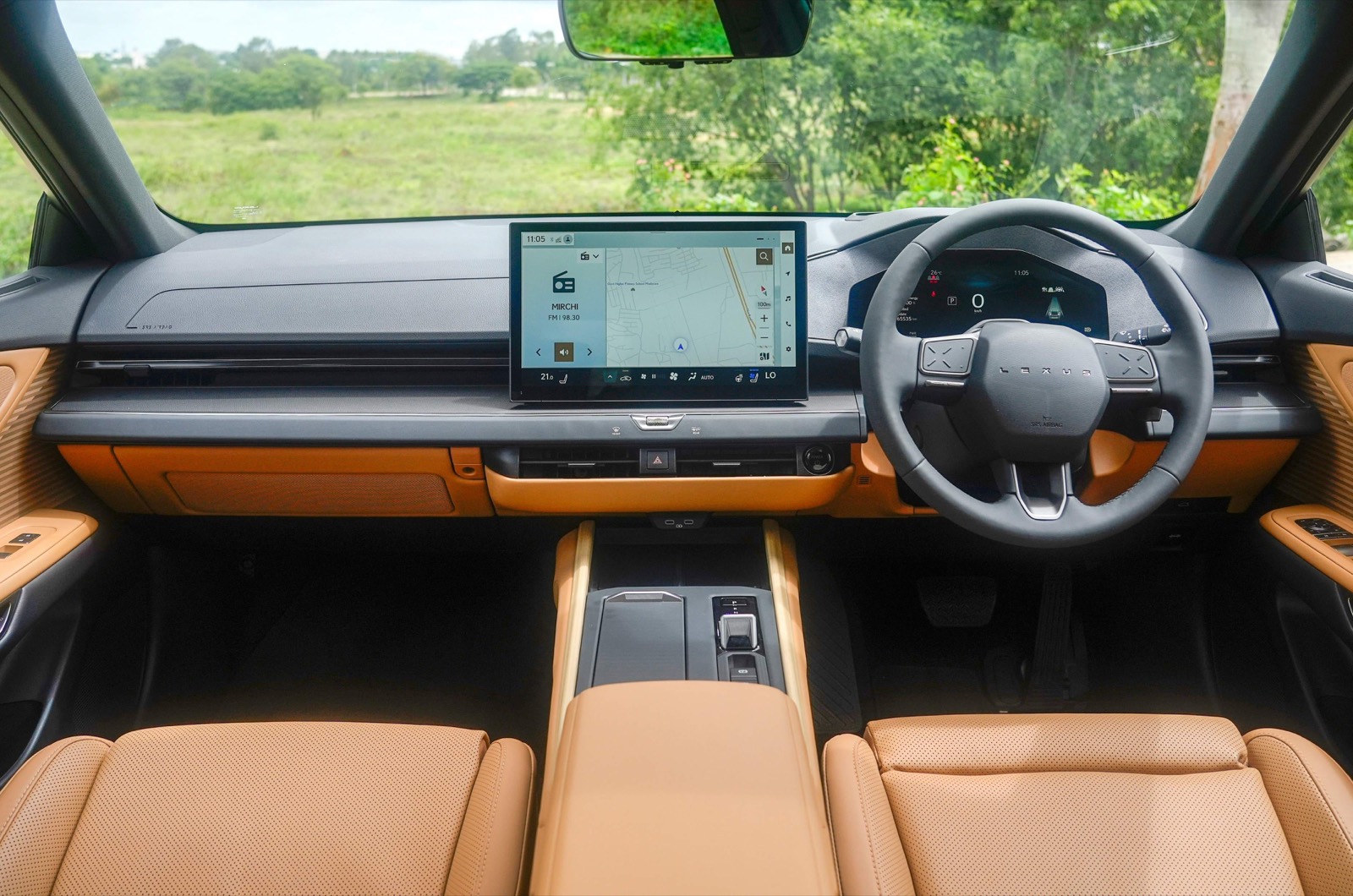
A dashboard with no visible controls photographs beautifully, and every second car company has decided that a clean render is worth more than a knob you can find without looking. The ES buyer wants controls that work the same at midnight on the Mumbai-Pune Expressway as they did in the showroom.
Then the rear seat. The new ES is 80 mm longer in the wheelbase and the legroom is plentiful. The floor is also raised, so the rear passenger sits knees-up, and the backrest no longer reclines. There are no sunblinds on the 350h at all, and no rear seat, sunroof or media controls, in a car largely meant for chauffeur-driven customers. The reclining seat with the ottoman exists in the global catalogue, on the top electric grade. It did not come to India.
And the looks. The old ES was the last Lexus you could park outside a hotel without explaining it. The new one has a closed-off nose, a coupe roofline and creases that look like they were argued over, in a design language Lexus calls Provocative Simplicity. Read the other way it is understated and short on road presence. Either reading lands in the same place: it is no longer the elegant, slightly anonymous thing that made an ES buyer feel they had spent well.
The car that kept the brief
The uncomfortable part for Lexus India: Toyota sells a car on the same TNGA-K platform, with the same 2.5-litre hybrid family, out of the same Bidadi plant, that kept every item on the old ES's list. The ninth-generation Camry launched in December 2024 at ₹48.69 lakh, fully loaded. It has power-reclining rear seats, a powered rear-screen sunshade with manual blinds on the side windows, rear controls in the armrest, physical climate buttons under its 12.3-inch screen, nine airbags and a Level 2 driver-assistance suite.
| Camry | ES 350h Exquisite | ES 350h Luxury | ES 500e | |
|---|---|---|---|---|
| Ex-showroom | ₹48.69 lakh | ₹66.10 lakh | ₹71.80 lakh | ₹89.99 lakh |
| Powertrain | 2.5 strong hybrid, 230 PS | 2.5 strong hybrid, 244 PS | 2.5 strong hybrid, 244 PS | 74.68 kWh, dual motor, 343 PS |
| Length / wheelbase | 4,920 / 2,825 mm | 5,145 / 2,950 mm | 5,145 / 2,950 mm | 5,145 / 2,950 mm |
| Rear seat recline | Powered | No | No | No |
| Rear sunblinds | Powered rear screen, manual sides | No | No | Manual |
| Climate controls | Physical buttons | Hidden touch switches + screen | Hidden touch switches + screen | Hidden touch switches + screen |
| Front ventilated seats | Yes | No | Yes | Yes |
| Airbags | 9 | 8 | 8 | 10 |
| Speakers | 9, JBL | 10 | 17, Mark Levinson | 17, Mark Levinson |
| Sunroof | Single pane | Single pane | Single pane | Panoramic |
| Vehicle warranty | 3 years / 1,00,000 km | 8 years / 2,00,000 km | 8 years / 2,00,000 km | 4 years |
Read the middle rows. The three things the old ES buyer paid for are the three things the Camry has and the ES does not. The extra ₹17.41 lakh buys 225 mm of car, an eight-year warranty, a better sound system on the Luxury, and a dashboard you have to learn.
Some of the Lexus case is real. The ride, on 19-inch wheels with tall sidewalls, is genuinely soft, the hybrid is quieter than the Camry's, and 800 km between fills is a number no German at this money can touch. At ₹66.10 lakh it undercuts the E 200 by ₹13.90 lakh and the 530Li by ₹9.70 lakh. It is value, just for a different person than the one who used to buy it.
axler8's take
The old ES was the smartest ₹65 lakh a chauffeur-driven buyer could spend here. Lexus has fixed it in every way except the one that mattered.
If you want what an ES used to be, the reclining seat, the blinds, the buttons, the hybrid quiet, Toyota is selling it at ₹48.69 lakh under its own badge. If you want the new ES, it is a fine car for the person holding the wheel. In India, that was never who signed the cheque.
The axler8 recommendation engine has no opinions about this. It scores the Camry and the ES on the same 1,521-variant sheet and lets you weight the rear seat as heavily as you like.
Cars in this story
- Toyota Camry, from ₹48.69 lakh ex-showroom
- Lexus ES, from ₹66.10 lakh ex-showroom