From the Apex · Axle to Grind ·
MG has launched one new car with two completely different cars underneath it.
The Hector Tomahawk is an EV and a plug-in hybrid on the same floor. That is how cars will increasingly be built, and India's tax code has not noticed yet.
- One body, two architectures: a 69.2 kWh electric car and a 20.5 kWh plug-in hybrid share every hard point.
- This is where the industry is going. One floor, many badges, many energies, tuned market by market. MG's SAIC parentage makes it the obvious first mover here.
- The plug-in works like the old Honda Accord Hybrid did: battery alone, engine as generator, both together, or engine direct. With a socket added.
- The catch is tax. India charges the plug-in 40 percent and its electric twin 5, so the smarter engineering carries the bigger bill.
One body, two powertrains, and a preview of how most cars will be engineered by the end of the decade.
On 26 August MG launched the Hector Tomahawk twice. Four electric variants, ₹19.50 lakh to ₹23.50 lakh, five or seven seats, a 69.2 kWh pack, 517 km claimed, deliveries from September. Then two plug-in hybrid variants at ₹25.70 lakh and ₹27.80 lakh, seven seats only, deliveries from November. Same 4,745 mm body, same 2,810 mm wheelbase, same screens, same badge. Underneath, two different cars.
MG calls the architecture ADAPT and sells it as India's first multi-energy platform: one set of hard points that will take a full EV, a hybrid, a plug-in or a range extender. The marketing is breathless, but the idea is sound, and it is worth understanding, because it is about to become the normal way a car company builds a car.
Two cars, one floor
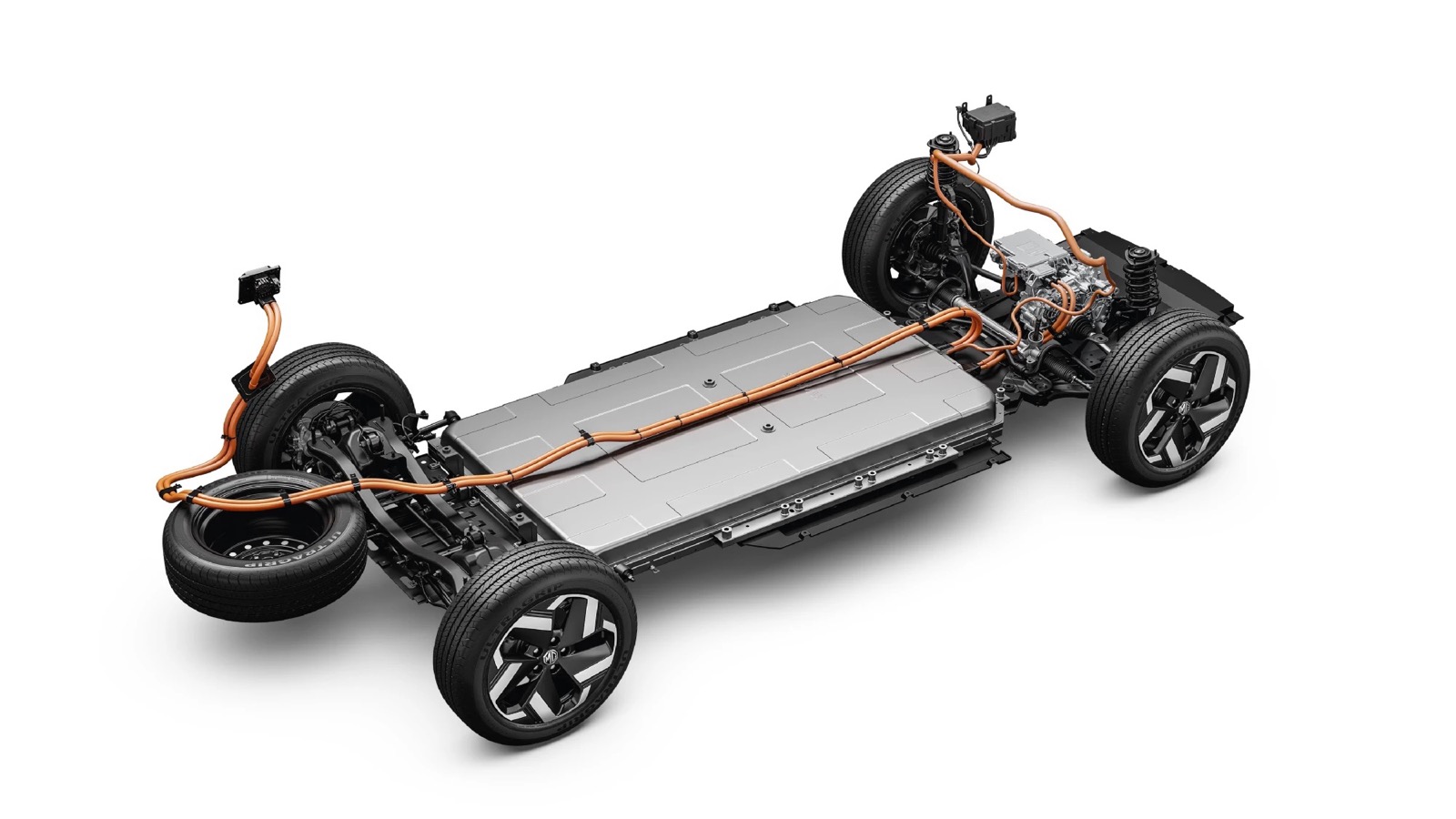
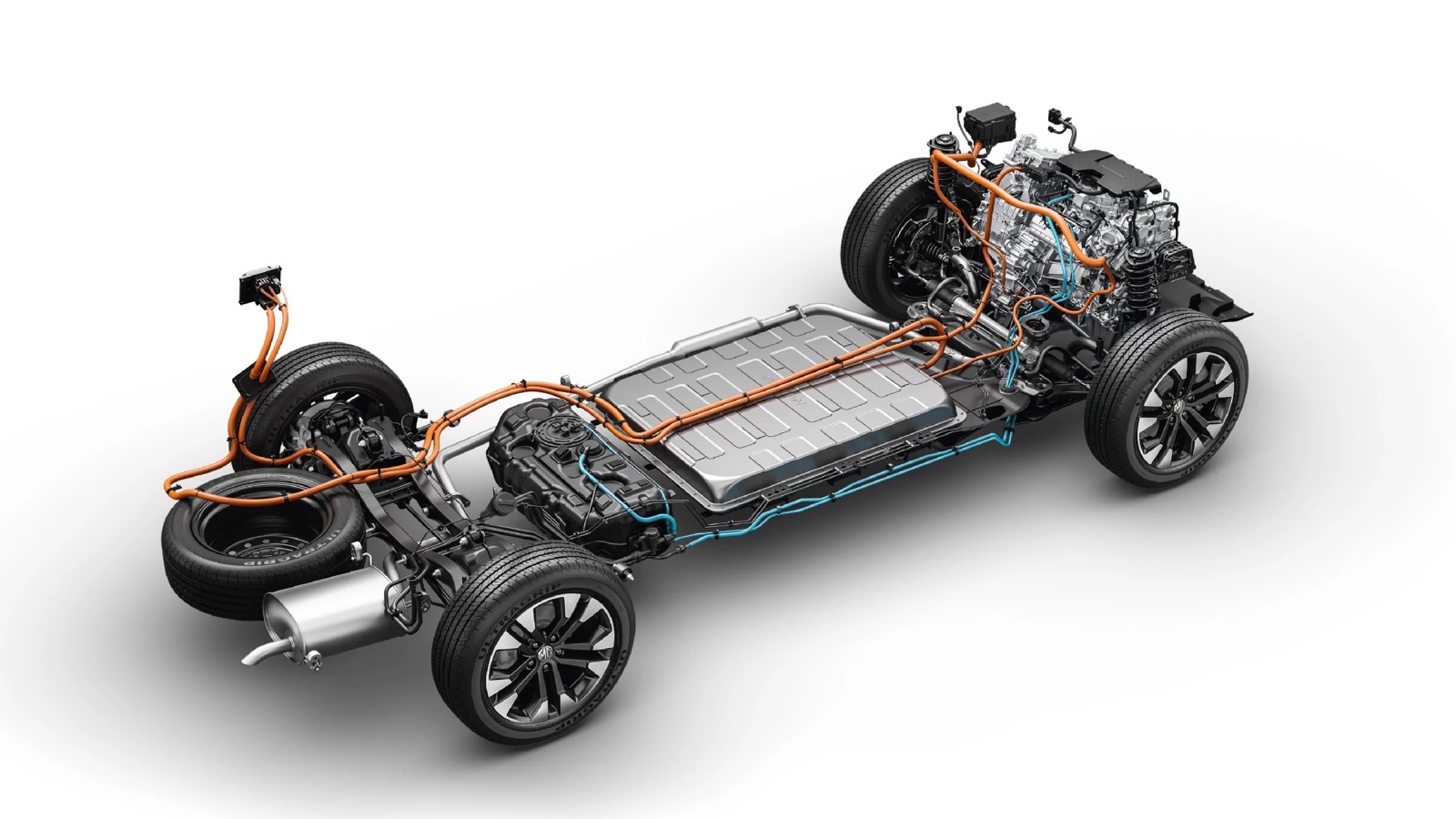
The electric Tomahawk is the straightforward one: a big battery in the floor, a motor on the front axle, 7.4 kW AC and 90 kW DC charging. The plug-in is the clever one. A 20.5 kWh pack, a 1.5-litre Atkinson-cycle petrol engine running as a dedicated hybrid unit, a motor, and a control system that shuffles between four ways of moving the car without asking the driver. On the battery alone, for a claimed 115 km. As a series hybrid, where the engine never touches the wheels and only runs as a generator to keep the battery topped up, which is what it does in traffic. As a parallel hybrid, engine and motor both driving, when you want everything at once. And engine direct, on the highway, where sending petrol power straight to the wheels wastes the least.
Anyone who has driven a Honda Accord Hybrid will recognise that list. Honda's i-MMD system, which came to India in the Accord in October 2016, did exactly the same dance: electric drive, hybrid drive with the engine generating and the motor pushing, and a lock-up clutch for engine drive at cruising speed. What the Accord could not do was take electricity from a wall. MG has added the socket, and a battery ten times the size, and that is the whole difference between a strong hybrid and a plug-in. The idea itself is a decade old and it was already excellent.
Why this is the future, not a gimmick
The reason to care is not the Tomahawk. It is what the Tomahawk tells you about how cars are going to be built.
MG is the obvious first mover in India because MG is SAIC, and SAIC has been doing this for years. The Hector itself began as a Baojun 530. The Windsor is a Wuling Cloud EV with a different grille. The Comet is a Wuling Air EV. The Gloster is a Maxus D90. One engineering programme in China, a handful of badges, and the same floor tuned for whichever market and whichever fuel it lands in. The Tomahawk extends that logic from badges to energy sources: the same platform now has to serve a buyer in Gurugram with a home charger, a buyer in Ranchi without one, and, eventually, a market that wants a range extender.
Everyone else is heading the same way, just more slowly. Toyota and Maruti already share bodies in India, Glanza and Baleno, Hyryder and Grand Vitara, Taisor and Fronx. Skoda and Volkswagen build four cars off one MQB A0 IN floor in Pune. Renault and Nissan have just done it again with the Duster and the Tekton. Globally, Stellantis calls its version STLA Medium and Geely calls it GEA, and both are explicitly designed to take petrol, hybrid, plug-in and full electric on the same hard points. Developing a platform is the expensive part of building a car. Developing one that can be sold as three different cars in three different markets is how you afford it.
For the buyer, the upside is choice without a price penalty for the tooling. The downside is that the badge on the nose stops telling you much about what is underneath, and the spec sheet starts mattering more than the brand.
The bit India has not caught up with
Here is where the Tomahawk's clever engineering meets an unclever rate schedule. GST 2.0, in force since 22 September 2025, taxes electric cars at 5 percent and every kind of hybrid, mild, strong or plug-in, exactly like a petrol car: 18 percent if it is small, 40 percent if it is not. The Tomahawk PHEV is 4,745 mm long with a 1.5-litre engine. It is a 40 percent car parked next to a 5 percent car that shares its floor.
You can read that straight off the price list. The PHEV Exclusive costs ₹3.70 lakh more than the seven-seat EV Exclusive, the PHEV Essence ₹4.30 lakh more than the EV Essence. For that money the buyer gets a smaller battery and slower charging, 3.3 kW AC and 25 kW DC against 7.4 and 90, and in return the one thing the EV cannot offer: a petrol tank and a combined range MG puts north of 1,100 km.
India has never had a plug-in hybrid market because it has never had a plug-in hybrid tax rate. Our September snapshot carries 1,521 variants on sale. Thirteen are plug-in hybrids, two of them the Tomahawk, and the other eleven come from Mercedes, BMW, Lamborghini, McLaren and Ferrari, starting at ₹145 lakh.
The Accord is the precedent here too, and not a happy one. Imported whole from Thailand at ₹37 lakh, it had sold 58 cars by May 2017. Then GST arrived and hybrids went to 43 percent all in, the Accord drifted to ₹43 lakh, and Honda dropped it in 2020. A few weeks ago I walked past one in mint condition and held my breath, the way you do for a car you never expected to see again. Brilliant powertrain, killed by a rate schedule.
MG is better placed than Honda was. The Tomahawk is built in Halol, not shipped from Bangkok. The Windsor sold 46,735 units in 2025 and was India's best-selling electric car, so there is a working EV business to absorb a slow plug-in. And Battery as a Service, ₹21.79 lakh up front plus ₹3.20 per kilometre, drops the plug-in's sticker below the top EV trims for the roughly 15 percent of MG buyers who take that route.
The one habit that decides it
The plug-in's economics only work if the owner actually plugs in. MG's own figures put it at about ₹1 per kilometre on a charged battery, ₹3 to ₹3.50 if you charge once or twice a week, and roughly ₹5 if you never charge at all. That last number is the trap. This car is aimed at the buyer who does not trust charging infrastructure, and it only justifies its tax bill if that buyer charges it every night. A plug-in hybrid that never gets plugged in is a heavy petrol SUV with an expensive battery in the floor.
Two smaller cautions. MG's brochure marks both the 115 km electric range and the 1,100 km combined figure as awaiting final certification, and the Tomahawk has no crash rating yet from any programme.
axler8's take
The clever thing here is not the plug-in hybrid. It is the floor it sits on. One platform, two energies today and a third promised, sold under a badge whose Chinese parent already runs the same play across four continents. That is the shape of the next decade of car-making, and India is getting an early look at it in a seven-seat SUV from Halol.
Which one to buy is simpler than the engineering. Charge at home every night and do the occasional Delhi to Jaipur run without thinking about it, and the plug-in moves seven people for about a rupee a kilometre with a petrol tank as insurance. Leave it uncharged and you have paid a 40 percent tax rate for a heavier Hector. For everyone else, the EV next to it is the same car with a bigger battery and a smaller bill.
I hope the plug-in does better than 58. The last car in India that could drive itself four different ways got taxed into a unicorn, and I still stop to look at those.
Cars in this story
- MG Hector, from ₹11.99 lakh ex-showroom
- MG Hector Tomahawk EV, from ₹19.50 lakh ex-showroom
- MG Hector Tomahawk PHEV, from ₹25.70 lakh ex-showroom
- Toyota Glanza, from ₹6.73 lakh ex-showroom
- Maruti Suzuki Baleno, from ₹5.99 lakh ex-showroom
- Maruti Suzuki Grand Vitara, from ₹10.77 lakh ex-showroom
- Maruti Suzuki Fronx, from ₹6.85 lakh ex-showroom
- Renault Duster, from ₹10.49 lakh ex-showroom